On April 3, the 17th meeting of the Automated Driving Standards Working Group, under the Sub-Committee on Intelligent and Connected Vehicles (SAC/TC114/SC34) of the National Technical Committee of Auto Standardization, was successfully held in Suzhou.
As one of the world's leading autonomous driving companies, Momenta hosted the meeting, joining experts and representatives from leading domestic and international automakers, component suppliers, testing bodies, and research institutes to advance the development of China's intelligent connected vehicle standards system and to further the research and formulation of automated-driving-related standards—in line with the requirements of documents such as the "Outline for the Development of National Standardization."
To date, Momenta has surpassed 170 design wins (model nominations), reached 700,000 mass-produced vehicles, and accumulated more than 7 billion kilometers of driving data. Drawing on the technical experience and massive data gathered through its intelligent assisted driving mass-production projects, Momenta has taken part in drafting several national standard projects in the field of driving automation – covering both ADAS assisted driving and AD (automated driving) – providing strong technical support and practical experience for the formulation of the relevant standards and market-access policies.
A scientific, rigorous standards system is the precondition for the large-scale, high-quality development of China's intelligent connected vehicle industry – and, even more, the key to safeguarding user safety. As a member organization of the Automated Driving Standards Working Group, Momenta upholds its vision of "saving one million lives in ten years," actively contributing to the formulation of China's automated driving standards and continuing to work with industry partners. Advancing on two fronts – standards leadership and technological innovation – it aims to promote the safe, orderly, and rapid development of the intelligent mobility industry and to create a safer, more convenient, and more efficient future of smart mobility for users.
--The following section is partly reprinted from the China Automotive Standardization Research Institute (CASRI).--
From March 30 to April 3, 2026, the Secretariat of the Sub-Committee on Intelligent and Connected Vehicles (SAC/TC114/SC34) of the National Technical Committee of Auto Standardization (hereinafter "the Secretariat") organized a series of meetings on intelligent connected vehicle standards, together with the 17th meeting of the Automated Driving Standards Working Group, in Suzhou. More than 130 experts from domestic and international vehicle manufacturers, component suppliers, testing bodies, and research institutes attended. The meeting was hosted by Momenta.
From March 30 to April 2, the Secretariat convened industry experts for project-group meetings on a series of standards. These draft standards span three distinct scopes under the SAE J3016 / GB/T 40429 taxonomy: automated driving systems (Level 3+), the driving-automation umbrella (Levels 0–5), and ADAS active-safety and driver-assistance features (Levels 0–1). The standards covered include:
· Intelligent Connected Vehicles — Safety Requirements for Automated Driving Systems
· Intelligent Connected Vehicles — Safety Requirements for Automated Parking Systems
· Intelligent Connected Vehicles — Test-Site Methods and Requirements for Automated Driving Functions
· Intelligent Connected Vehicles — Road-Test Methods and Requirements for Automated Driving Functions
· Intelligent Connected Vehicles — Coordinate Systems
· Road Vehicles — Test Scenarios for Automated Driving Systems — Scenario Classification
· Road Vehicles — Test Scenarios for Automated Driving Systems — Scenario Evaluation and Test-Case Generation
· Intelligent Connected Vehicles — Simulation Engineering for Driving Automation Systems — Part 4: Implementation Methods and Requirements for Simulation Testing
· Technical Requirements and Test Methods for Automatic Emergency Braking Systems of Heavy-Duty Vehicles
· Technical Requirements and Test Methods for Lane-Keeping Assistance Systems of Light Vehicles
· Automotive Software Identification Code
· Technical Requirements and Test Methods for On-Board Positioning Systems — Part 2: Inertial Navigation
· Road Vehicles — Controller Area Network (CAN)
The meetings examined in depth the standards frameworks, technical requirements, and test methods of each project, advancing their formulation and successfully meeting the objectives set for the session.
On April 3, the Secretariat convened the 17th meeting of the Automated Driving Standards Working Group. The meeting first reviewed the work of the Sub-Committee on Intelligent and Connected Vehicles and the Automated Driving Standards Working Group, and set out the subsequent work plan. The lead organizations of each project group then reported on recent progress for the automated-driving-focused standards in the series above – covering safety requirements for automated driving and automated parking systems, test-site and road-test methods, coordinate systems, test-scenario classification and evaluation, and simulation engineering for driving automation systems. Attending experts offered a number of suggestions on the reports and research findings, jointly advancing the research and formulation of standards in the automated driving field.
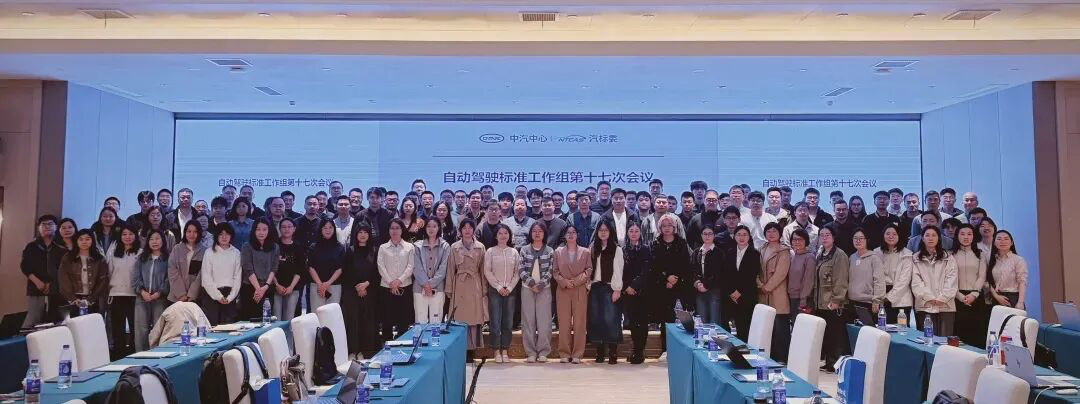
The meeting comprehensively summarized the results of earlier work and laid out a sound plan for the next steps. Going forward, under the guidance of the competent authorities, the Secretariat will continue to refine the technical content of the standards, mobilize industry resources, advance the development of the intelligent connected vehicle standards system, and foster a thriving industry.


 Back
Back


